


Your Forgotten Audience
Recently an author client reported to me that she thought her blog posts that related to her books/writing and her site should be phased out. She had received some emails from her fan base saying they preferred her posts that were focused on life: motherhood, weight issues, relationships and such. In response, she wanted to be in line with what her audience wanted.
 Okay, so this may be true for those dozen (or three) people who wrote in. And I absolutely respect how loudly such comments can color your opinion of your own content. But do not forget, that your loudest contingent is rarely your largest, most representative, or your only. This is directly related to: what your audience wants may not necessarily be what your business goals dictate, but that’s fodder for a different topic.
When designing your content you must consider all your audience sectors — the hard-core invested, the curiously interested, and the merely intrigued. You need both sales content and reinforcement content. You need several lures. You can’t put it all on your home page, (that will look like a circus), but nor can you fill your blog with only one audience appeal. These are your portals. This is where your audience –all of it– first sees you. Be welcoming and encouraging. Optimized content (and UI for that matter) should consider that your audience consists of varying levels, with varying needs.
Granted, there are definitely instances where a single comment can bring a valid issue to light. A client once had us change something on her site that required over three hours of work to accomplish. This in response to one email from a single librarian who thought something was confusing. In this case, it was confusing, and directly related to understanding a specific product. We –on the inside– had never seen it as such.
Here is a short tale of what it feels like to be the audience who is forgotten (or jump to the upshot at the bottom of this post):
For me, it was yoga. Once upon a time I went somewhat regularly. Then life, motherhood, and work messed with my schedule and suddenly I was years out and my stamina was gone. Every time I tried to get back to yoga I felt like the cross-eyed stepchild in the back of the room who couldn’t hold a downward facing dog for any respectable stretch.
I passed my neighborhood yoga studio and looked at the window wistfully and longingly. I felt that they did not have classes for me. I couldn’t justify the time for something I knew I wouldn’t get, and when I did I was disheartened by the end. I needed to be eased back in. I needed shorter, more basic classes and my neighborhood studio felt closed to me. I was a different audience from the norm. I knew I wasn’t alone because I’d heard the moms at the local park talking, and when I caught snippets of the conversation of the people in front of me in line at Trader Joe’s describe going to said studio as intimidating, I thought: Well, that’s just bad branding.
I finally said something to the studio, and they were stunned. Of course we have classes for you!
Maybe I had just missed it. So I looked again at their newsletter, pointing to info about advanced workshops. New level 2 classes, etc. Well, that’s what our regulars were asking for. And the woman behind the desk brought up their site on her computer, clicked around, and then proudly showed me a class embedded in the schedule with the subtitle: Ideal for beginners, seniors, and rehab.
Okay. Sure. You need to appeal to your regulars. I get that. But how can you grow your audience if you ONLY appeal to those you already have? How was I supposed to know where to look? Or, as a woman in her 40s, did I really want to classify myself as a senior?
I suggested a small invitation in their window, website, and on their newsletter: NEW TO YOGA? or EASE YOGA BACK INTO YOUR LIFE or WE HAVE BEGINNER CLASSES! They needed something inviting that spoke to this forgotten audience — Yes, we have content for you. Follow this little icon to these classes…
Upshot / Moral of the story: Diehards will ignore what they don’t love. They will remain devoted unless you tick them off. The quiet, forgotten audience will rarely speak up…and you need them, too.
Industry Speak
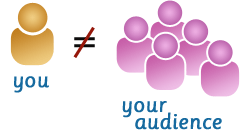 A frequent problem in any industry is the tendency to speak to your audience in terms and timing that make sense to you. But you are on the inside. Your audience is not. But the same thought process should be considered when writing web copy.
I have a client who uses the term “POV” in her blogging and other webcopy. And while her writerly site visitors might know that POV refers to character Point Of View (aka, who is speaking, whose head are we in), most readers do not. It can be jarring for them. Moreover, when they are next reading your work, they might slip out of reading mode to notice your POV change. Suddenly, reading is no longer an immersive experience, and the brand has a seam.
It’s a matter of putting yourself in your visitors’ shoes. Speak in terminology that is meaningful to them. When you don’t, you risk mismessaging. And while sometimes that means that your message simply might not translate, it also can mean that you actually offend the reader since suddenly they have no idea what you are talking about (and no one likes to feel ignorant). And when you are writing fan-based web copy your goal is to connect, not to jar. Speaking a different language will not help.
Audience-aimed copy can also work towards luring your audience into a tighter bond with you. An example: I regularly advise author clients not to announce new books in terms of contracts: “Good news! I just signed a contract for two more books!” This is industry speak. Now look how much more audience-oriented this is:
“Good news — more books to come. You can now count on two more books from me in 2016! Stay tuned for titles and more definitive dates.”
This is meaningful to the audience. You are putting it in their terms, that they get to read more books (not that you will remain gainfully employed). Moreover, you allow for a little magic to be retained. Instead of putting your future booklist in terms of negotiations and contracts, it can feel unencumbered and organic, as if the stories flow from your hand to theirs without the tedium and tension of publishers and distribution and all that in between. You are in the business of expecting your consumers to suspend reality. Don’t shoot yourself in the foot by demystifying your product. There is no need to advertise how much of a product your product is.
Think like your audience. How do you want them to read your news?
Ordering Buttons… We’re Sharing!
Once upon a time we created a set of ordering icons. We keep adding more icons to the mix, and we post them here to share them with you!
Amazon Print, Kindle, and UK Icons:




Barnes & Noble Print and Nook Icons:

Other Digital Resalers:





Publisher Icons:


Goodreads and Library Thing:


A Few More:



Shockingly, online bookstores did not have buttons like these for use — not even kindle or nook. Eloisa James was the first of our authors to launch our new order structures. As soon as we started designing these for Eloisa, Julia Quinn and Stephanie Tyler said, “Me, too, please,” and several more eagerly followed suit getting their request into our queue. Unlike most design work where the copyright is held by the designer, we designed these for the public domain. Go ahead. Lift them (copy to your own server, of course, but please keep “waxcreative” in the file name.). All we ask is that you credit us somehow — on your site credits page, in the code… somewhere. Thanks.
The Loyal Reader Giveaway
The Loyal Reader Giveaway is a way for authors to reward their readers for subscribing to their newsletter.
All readers have to do to win a book is subscribe to the author’s newsletter and stay subscribed. Every month someone will win a free autographed book. One Loyal Reader is randomly drawn per month (regardless of how recently they signed up). Plus they’ll enjoy the author’s newsletter, telling them about new excerpts and book releases right in your inbox.
That’s really all it takes! Cool, right? It’s a great “thank you” to readers for joining an author’s newsletter list!
This is also a great way to promote backlist books, especially for authors with hard-to-find early editions.